
. .
2026 Frost Farm Prize for Metrical Poetry
The 2026 contest is now complete. Thanks to all who entered! The winner and honorable mentions have been notified.
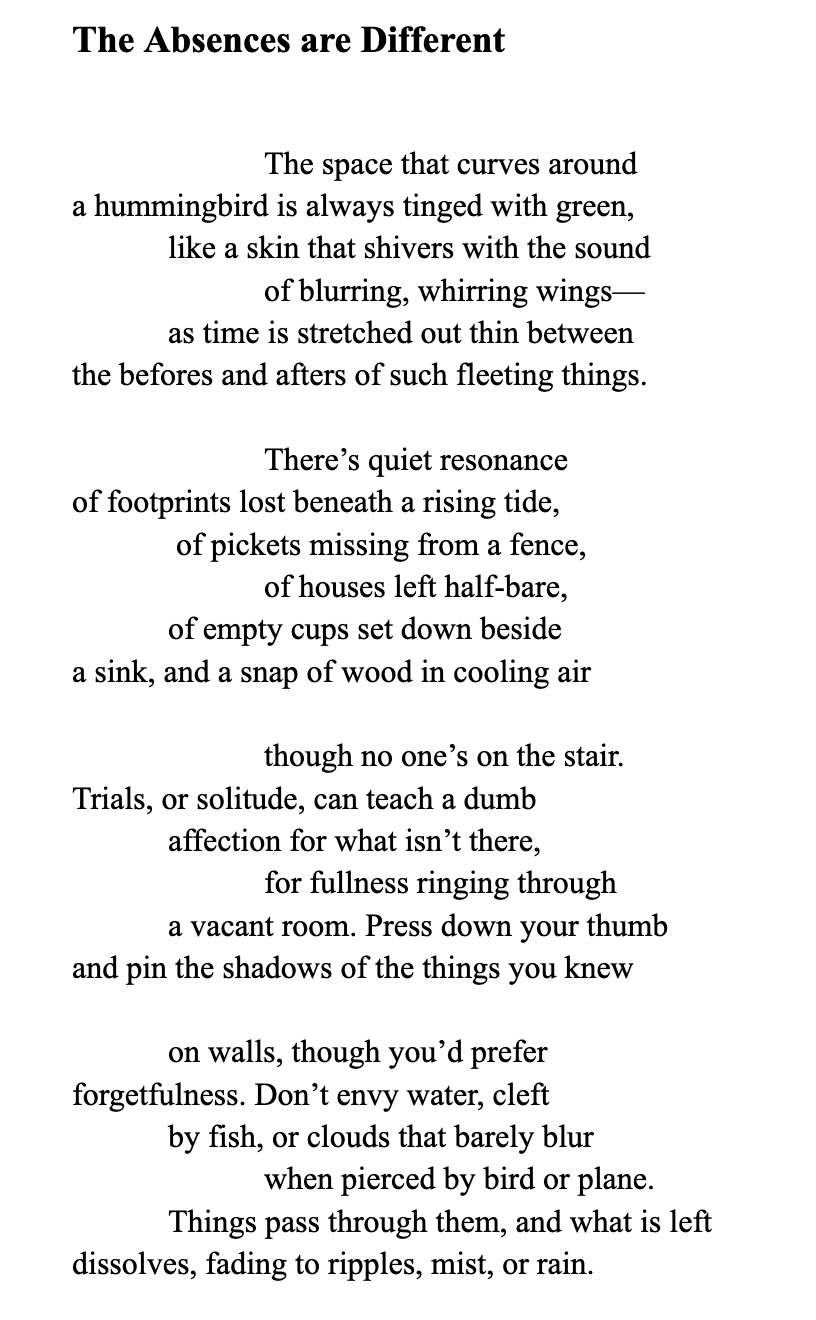
The Trustees of the Robert Frost Farm in Derry, N.H., are pleased to announce that the winner of the 17th Annual Frost Farm Prize for metrical poetry is Carla Galdo of Lovettsville, Virginia, for her poem “The Absences Are Different.”
The 2026 Frost Farm Prize judge, Ryan Wilson, selected the winning poem after reading over 600 anonymous entries. He had this to say about the winning poem:
“The Absences are Different” is a poem, paradoxically, about presences, specifically the presence of “such fleeting things” as hummingbirds, empty cups, tides, and memories. Comprised of six sentences—three indicative, two imperative, and a final indicative—the poem is not at all the straightforward piece of advice that such an arrangement might suggest. Rather, it is alive with verticality and verges on the Baroque with its elegant sestets—arranged 3A 5B 4A 3C 4B 5C—through which a fluent syntax cascades in such a way as to recall Donne, Herbert, and, perhaps more fully, Thomas Traherne, and yet the poem never feels archaic, or “old-timey,” but remains tenaciously grounded in our present.
Consider the first sestet, the music of which is exquisite. Dominated by liquid consonants, and especially the nasal “n,” in imitation of the “whirring wings” of the “hummingbird” (the reader may appreciate how both the “m” and “n” sounds in “hummingbird” actually force the one saying the poem aloud to “hum” through the nose), this sestet conjures the metaphysical through the physical. When the poet asserts that “The space that curves around / a hummingbird is always tinged with green,” the reader assents to the statement as literally true: we’ve all seen hummingbirds in the green of flowering bushes. But there is also a delicate metaphysical suggestion: namely, “the space that curves around” any mortal thing is always, in a certain sense, “green,” always alive with suggestions and recollections, “the befores and afters of such fleeting things.”
Indeed, this poem is haunted with a “quiet resonance,” or, rather, several quiet resonances. First, upon encountering the word “hummingbird” and “resonance” so near each other, the reader cannot help but hear a “resonance” of Emily Dickinson’s late masterpiece, poem 1463 (“A route of evanescence”). In Dickinson’s poem, the local hummingbird brings “the mail from Tunis,” news of another world. Similarly, in “The Absences are Different,” the hummingbird brings news from other worlds, news of “footprints lost beneath a rising tide, / of pickets missing from a fence, / of houses left half-bare, / of empty cups set down beside / a sink, and a snap of wood in cooling air …”.
Via the mind’s poetic associations, the present hummingbird with its swift movements inaugurates a society of memories and imaginings that move from here to there with lightning speed in the poem’s litany.
To note these swift transformations is to recall the musical modulation in stanza one, from “hummingbird” to “tinged” to “blurring” and “whirring” and “wings” and “fleeting,” with sonic variations in “green” and “skin” and “thin” and “between.” Moreover, noting these transformations, one also recalls that, behind Donne and Herbert and Traherne, lie Ovid and his Metamorphoses, adumbrated in the Ars Amatoria, two of the most impactful poems upon the Renaissance, the latter, especially, because it showed how love joins discrete entities into a unity.
In “The Absences are Different,” we see such a jointure: past and present are joined both literally and stylistically. And yet, the poem is neither mawkish, nor unduly neo-Classical. In stanza three, the poet writes, “Trials, or solitude, can teach a dumb / affection for what isn’t there, / for fullness ringing through / a vacant room.” There’s a hint of self-mockery in the Janus-word “dumb” (here meaning “silent” but also self-deprecatingly suggesting “stupid”) and in the “vacant room,” as any poet so savvy in imitation of stanzas recalling Donne would recall that a “vacant room” suggests a “vacant stanza.” (I’d be remiss not to note how the sound the poet has associated with the hummingbird comes back triumphantly in the phrase “fullness ringing” quoted above.)
In short, the poem is, for all its high polish, not at all hoity-toity. It confronts how the human mind can furnish the apparently blank or empty, can supplement what is given in each now with what has been taken from each now. Consequently, we’re instructed, “Don’t envy water, cleft / by fish, or clouds that barely blur / when pierced by bird or plane.” Why should we envy such things, through which what passes leaves only a brief mark. What passes through our lives can remain present to us, most especially our “loves,” this last a word which the poet has, in a feat of anagrammatic brilliance, dissolved in the word “dissolves.” For us, love may not dissolve in the transformation of all things, but may remain present with us, even when the beloved is gone, as all created things, such as hummingbirds and humans, will soon enough be.
Ultimately, “The Absences are Different” may recall Traherne, and Donne, and Dickinson, and Ovid, but its doing so is not empty show: the literary “resonance” embodies the poem’s argument, which is similar to that of Richard Wilbur’s fine late poem, “At Moorditch.” And, as Mr. Wilbur’s poems so often did, “The Absences are Different” offers a startling illumination of how presence itself is a lasting gift.
Galdo received $1,000 and will be a featured reader at The Hyla Brook Reading Series at the Frost Farm Poetry Conference on Friday, Aug. 14, 2026. The reading kicks off the 10th Annual Frost Farm Poetry Conference (Aug. 14-16, 2026).
Galdo had this reaction to winning the Frost Farm Prize: “Everything is gift—this is a phrase etched into the headstone of a dear mentor of mine who passed away a few years ago. When I consider the news that I have won the 2026 Frost Farm Prize for metrical poetry, these words come immediately to mind. There are so many gifts, and gift-givers, hovering in the background of “The Absences are Different” that it boggles my mind to think of them all. The most immediate gift that spurred the writing of this poem was a book suggestion: I was in the middle of following up on it, muddling my way through a text on phenomenology, when I came across the phrase that became the poem's title. But there are other, wider gifts at work, so many that it is impossible to list them all right here. For now I will just say that it was a gift to have the time and inspiration to write this poem, and a gift to be taught how. It is also a profound gift to be part of a growing community of poets who inspire me to persevere in the basics of reading, thinking, and writing. For all of this and more, I am both humbled and grateful.”
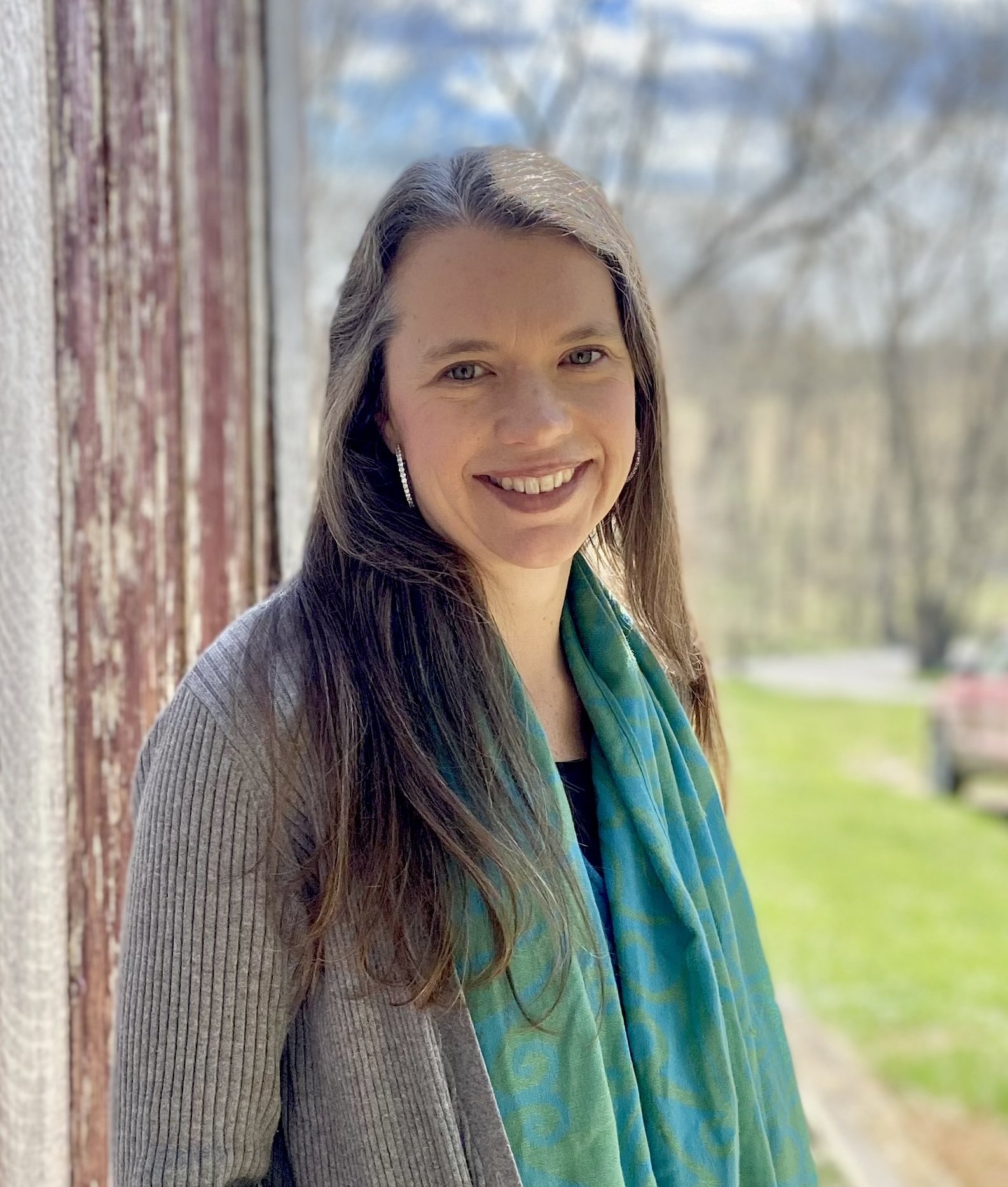
Carla Galdo is a poet, writer, and editor. She has written for a variety of publications, including Humanum, Word on Fire, Notre Dame Magazine Online, Our Sunday Visitor, Well-Read Mom, Front Porch Republic, and others. Her poetry has appeared in First Things, Dappled Things, Verily, Modern Age, New Verse Review, Solum Journal, and on Irish Southeast Radio. She is the recipient of the 2024 St. Austin Review Prize for Poetry. She has taught classes in literature, theology, poetry, and book reviewing. Carla earned a Master’s in Theological Studies from the John Paul II Institute for Marriage and Family and an MFA in Poetry from the University of St. Thomas-Houston. She and her husband live with their six children on a hobby farm in Virginia, and more of her work can be found at carlagaldo.com and on her Substack publication Where Feathers Pierce.
—Carla Galdo
In addition to selecting the winner, Ryan Wilson chose 1 Finalist and 12 Honorable Mentions:
Finalist:
"Day Drinking After Visiting My Mother" by Alice Allan of Melbourne Australia
Honorable Mentions:
“Ghost Leaves” by Blake Campbell of Lehigton, Pennsylvania
“The Burial” by Maya Venters of Glen Williams, Ontario, Canada
“Χορός” by Steven Searcy of Atlanta, Georgia
“Laetare” by Cara Valle of Dunn Loring, Virginia
“Maintenance” by Cara Valle of Dunn Loring, Virginia
“Aubade” by Benjamin Myers of Chandler, Oklahoma
“Po Polsku” by Carla Galdo of Lovettsville, Virginia
“Remembering the Fireflies” by Steven Monte of New York, New York
“Adgnosco Veteris Vestigia Flammae” by James Wilson of Grand Rapids, Michigan
“The Good Life” by Olivia Marstall of Sioux Center, Iowa
“Prayer against Despair” by Benjamin Rose of Arlington, Virginia
“As it is” by Steven Monte of New York, New York
Previous Frost Farm Prize Winners
2025 Christopher Childers of Los Angeles, California, for his poem, “Lalage.” —Judge Maryann Corbett
2024 Sarah Spivey of Oklahoma City, Oklahoma for her poem, “The Dispossession.” —Judge Mike Juster
2023 Brian Brodeur of Richmond, Indiana for “After Visiting a Former Student in a Psychiatric Unit” — Judge Alfred Nicol
2022 Jean L. Kreiling of Plymouth, Massachusetts for “Antiphon“ — Judge Allison Joseph
2021 Nicolas Friedman of Syracuse, New York for “Storylines” — Judge Aaron Poochigian
2021 Michael Levers of Provo, Utah for “The Counterweight” — Judge Aaron Poochigian
2020 Jennifer Michael of Sewanee, Tennessee for “Forty Trochees” — Judge Rachel Hadas
2019 David Southward of Milwaukee, Wisconsin for “Mary’s Visit” — Judge Bruce Bennet
2018 Susan de Sola of the Netherlands, for “Buddy” — Judge Melissa Balmain
2017 Caitlin Doyle of Cincinnati, Ohio, for "Wishes" --Judge Deborah Warren
2016 James Najarien of Auburndale, Massachussets for "Dark Ages" -- Judge David Rothman
2015 Kevin Durkin of Santa Monica, California for "Meteor Crater" - Judge Joshua Mehigan
2014 Rob Wright of Philadelphia, Pennsylvania for "Meetings with my Father" - Judge Rhina Espaillat
2013 Caki Wilkinson of Sewanee, Tennessee, for "Arts and Crafts" - Judge Catherine Tufariello
2012 Richard Meyer of Mankato, Minnesota, for, "Fieldstone" - Judge Richard Wakefield
2011 Sharon Fish Mooney of Coshocton, Ohio for "Dimly Burning Wicks" - Judge Bill Baer
About the Frost Farm’s Hyla Brook Poets
The Frost Farm was home to the poet and his family from 1900-1909. The Hyla Brook Poets, a 501(c)(3), started in 2008 as a monthly poetry workshop. In March 2009, the Hyla Brook Reading Series launched with readings by emerging poets as well as luminaries such as Maxine Kumin, David Ferry, Linda Pastan, and Sharon Olds. The Frost Farm Prize was introduced in 2010, followed by the inaugural Frost Farm Poetry Conference in 2015.

